What is a modular decking system?
Table of contents
12 sections
Most decks are still built by sourcing the pieces separately, and it works. It just puts every mismatch on the installer.
A modular system moves that coordination upstream, into the design phase of the product range.
What makes a range genuinely modular?
There are three aspects, and many products claim to be modular with only one of them:
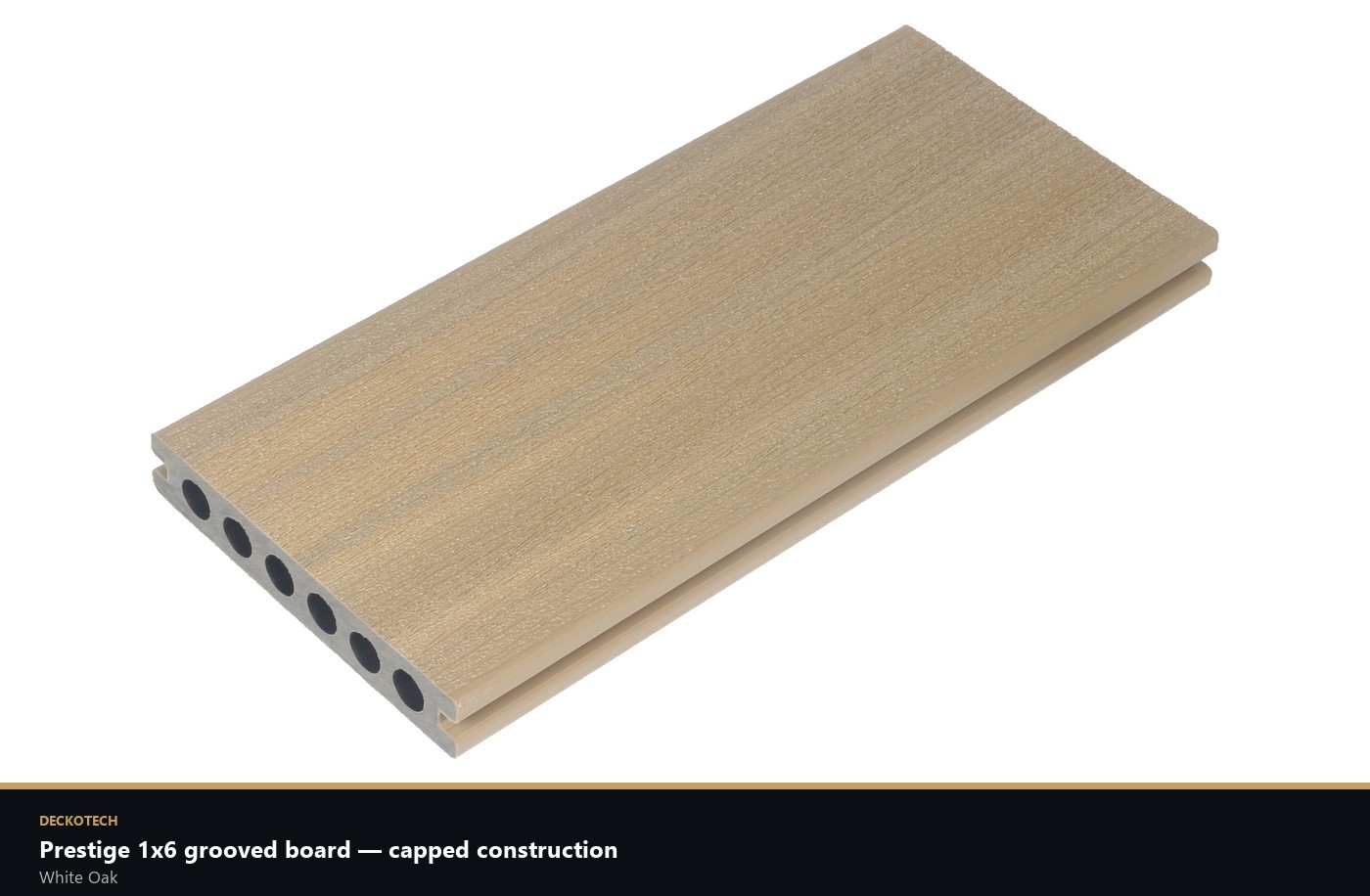
- One dimensional standard. Boards, slats and panels share a repeating module so the layout works out without ripping the last piece. A Deckotech Prestige decking board is actually 0.86" x 5.5" (22 mm x 140 mm) in 16 ft lengths — that actual figure, not the nominal 1" x 6", is what the rest of the system is designed around.
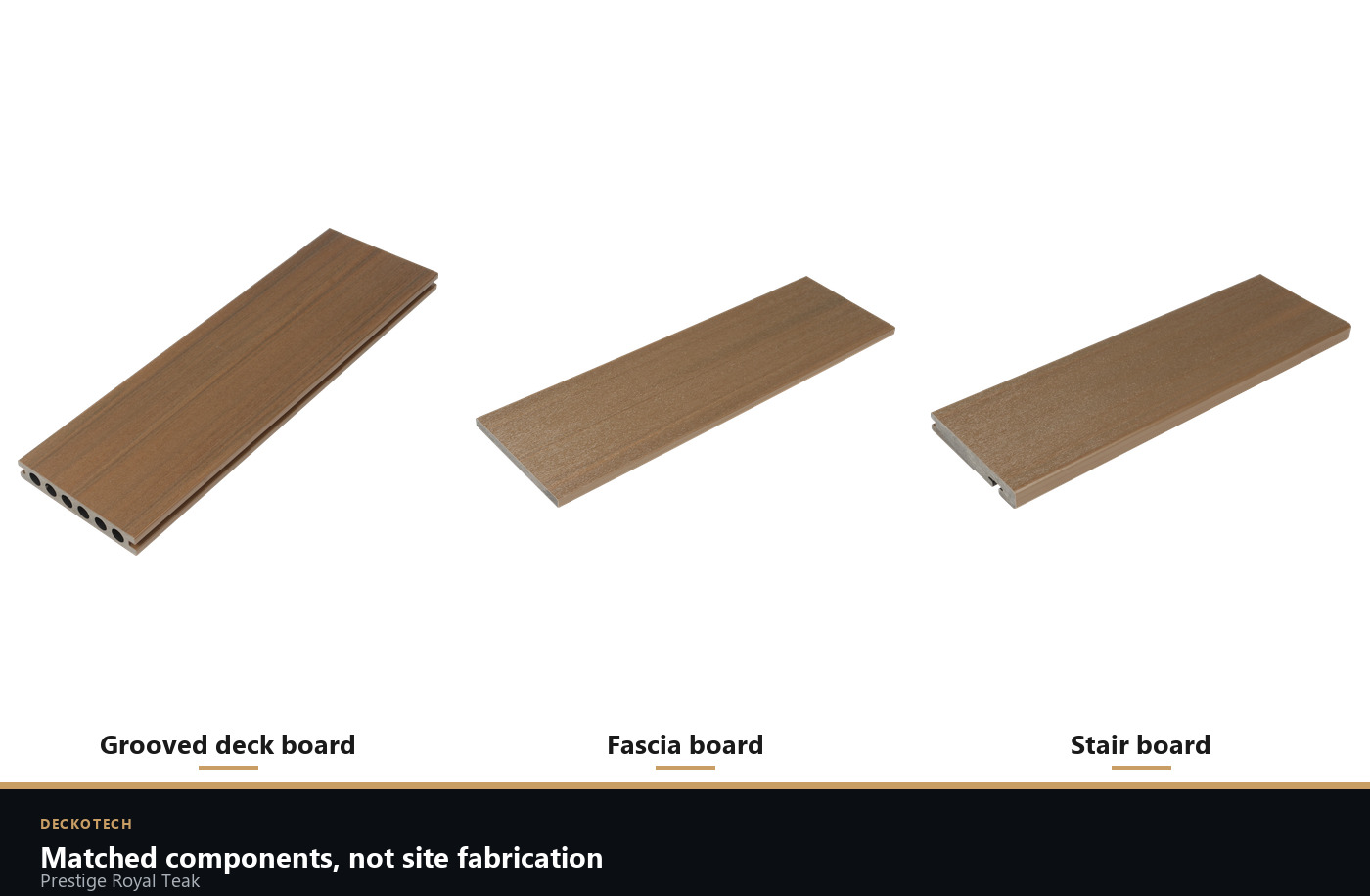
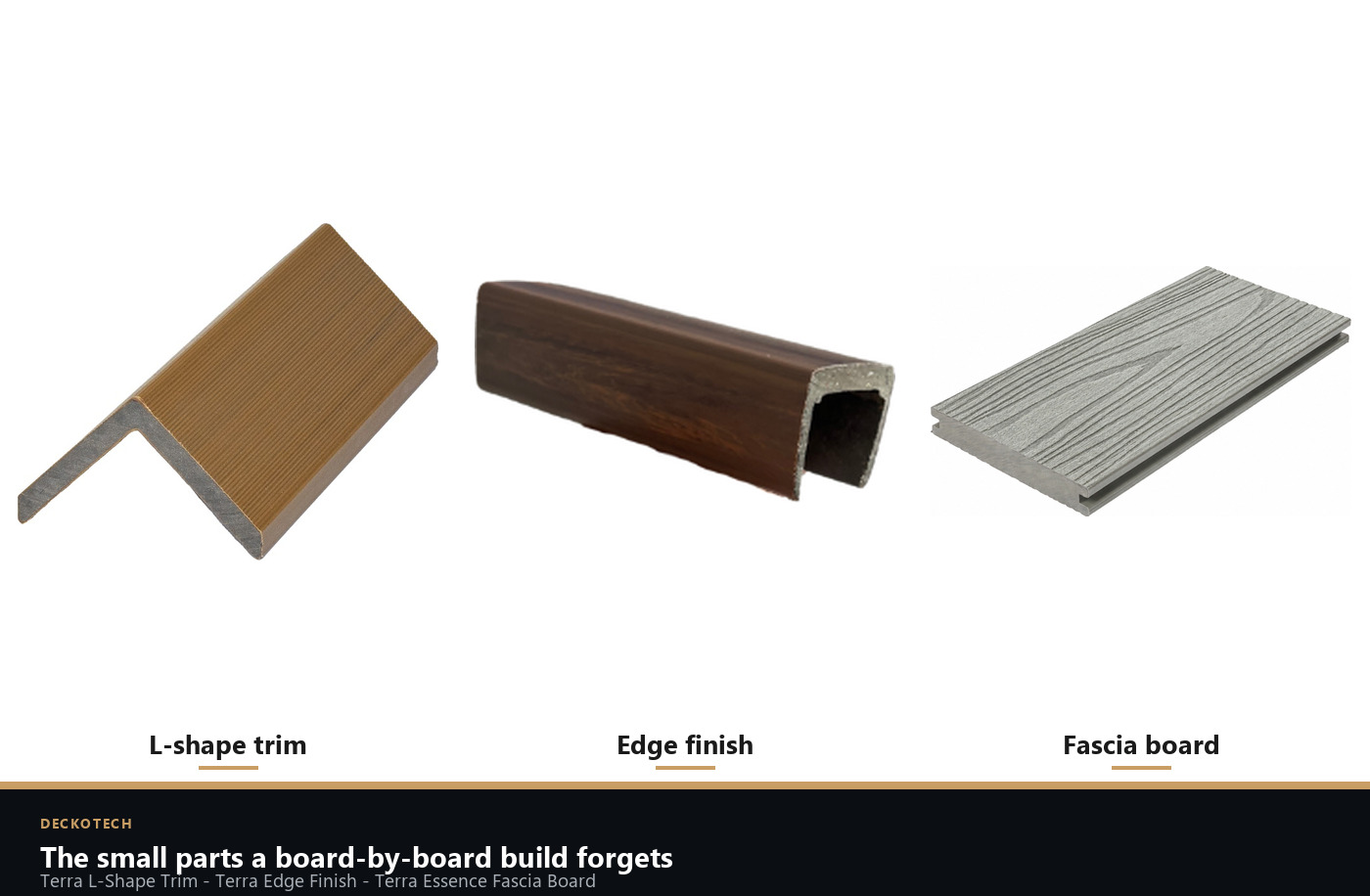
- Matched components across the deck. The fascia, the stair board, the clip, the screw and the edge trim exist as catalog items with defined interfaces, not as things you have to fabricate. Deckotech ships the Prestige fascia board and stair board in the same colors as the deck boards, so the edge of the deck and the nose of a step match the field instead of being cut down from a ripped board. Posts, rails and brackets belong to the fence and railing systems rather than to the deck surface, and they only enter the conversation when the project has a fence line too.
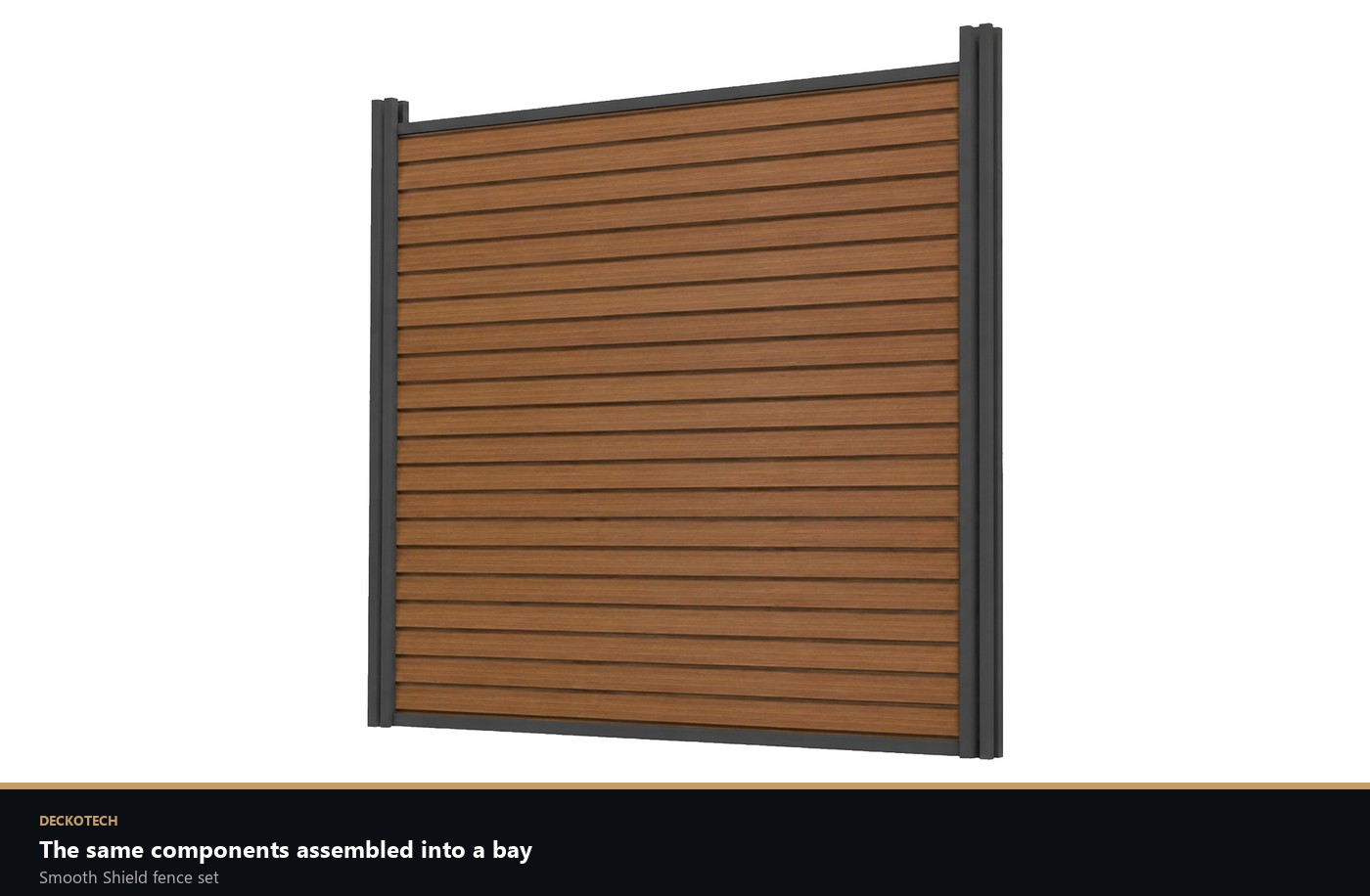
- Color continuity across product types. The same Royal Teak reads the same on decking, on cladding and on a fence board. This sounds cosmetic until you’ve got a deck and a facade meeting at a corner in two slightly different browns.
Where a system actually saves money
Not in the material invoice. Component for component, a coordinated system usually costs a little more than the cheapest equivalent parts bought separately. The savings are elsewhere:
| Cost line | Board-by-board | Modular system |
|---|---|---|
| Material unit cost | Usually lower | Usually slightly higher |
| Site fabrication labor | High: transitions, corners and trims are improvised | Low: components have defined interfaces |
| Offcut waste | Higher: layout rarely lands on a whole board | Lower: module is designed to repeat |
| Rework risk | Higher: tolerance mismatches surface during install | Lower: tolerances agreed in the catalog |
| Warranty | Split across several manufacturers | Single system warranty: Deckotech — confirm current terms |
| Color match across deck, fence and facade | Approximate | Exact, same pigment batch logic |
What our own search data says about this
This isn’t a category we invented for marketing. People search for it in these exact words: "decking systems", "modular decking systems", "decking modular", "modular outdoor decking". US search demand for "modular decking system" is up 387% year over year, and "composite decking systems" is up 189% over the same period.
The demand is real and it’s growing quickly. What is missing is anyone explaining the category properly, which is why most of those searches currently end on a generic product page.
How to specify a system without getting locked in badly
- Ask for the actual dimensions of every component, not nominal. Nominal figures hide the mismatches.
- Ask which components are catalog items and which the installer is expected to fabricate. The second list should be very short.
- Ask whether the warranty survives if one component comes from elsewhere. It usually doesn’t.
- Ask whether the same color exists across decking, cladding and fencing. If it doesn’t, the system is really just a decking range.
- Ask what happens in ten years when you need six replacement boards. Continuity of supply is a real risk with small brands.
Those five questions separate a genuine system from a catalog with a system-sounding name.
Frequently asked questions
What is a modular decking system?
A modular decking system is a range built to one dimensional standard, so the deck boards, fascia, stair boards and trims fit each other and the fixings made for them, without site fabrication. The alternative is board-by-board: buying decking from one supplier and sourcing every other component separately.
Is a modular system more expensive?
Component-for-component it’s usually slightly more. The savings show up in labor and in waste, because the parts are dimensioned to fit and the installer isn’t fabricating transitions on site. On small simple decks the math favors board-by-board; on anything with cladding, fencing or level changes it flips.
Can I use boards from another brand with a modular system?
Physically sometimes, contractually rarely. Mixing brands generally voids the system warranty, and clip and groove profiles aren’t interchangeable between manufacturers. If you want the warranty, keep the system intact.
Is it faster to install a modular system?
Generally yes, because the installer is fitting defined components rather than fabricating transitions. The gain is largest at edges, corners, level changes and where decking meets a vertical surface — precisely the details that consume disproportionate labor on a board-by-board build.
What components should a complete system include?
For the deck itself: deck boards, a fascia or edge board, a stair board wherever there are steps, a fixing method (hidden clips and screws, or face screws), and the trims that close the perimeter. Posts, post caps, rails and brackets are fence and railing parts, so they only belong on the list when the project includes a fence or a guardrail. If cladding and fencing come out of the same range, add the matching corner pieces and slats. Deckotech carries all of these as separate catalog SKUs.
Sources
- Deckotech product catalog, deckotech.us — component SKUs and actual dimensions; a manufacturer limited warranty (confirm current terms with your supplier).
- LBM Journal, decking market trends 2026 — industry shift toward simplified fastening systems and modular components.