Table of contents17 sections
What is capped composite decking?
If you’ve been shopping for composite decking, you’ve probably seen the word "capped" everywhere. The problem is that almost every brand says the same thing: it has a protective shell. That’s only half the story.
Without that protective cap the core of the board is exposed. Over time, uncapped composite decking is more likely to fade, stain and absorb moisture. That’s the single biggest reason the premium half of the category moved to capped composite decking boards.
So the quality of that protective layer is what really matters. A well-made cap helps your deck keep its color, resist stains and stay looking newer for longer. When you compare decking, don’t just ask whether it’s capped. Ask how it’s made. That’s one of the biggest differences between a deck that still looks great years from now and one that doesn’t.
The rest of this page answers exactly that question, in plain language, with the numbers underneath.
How is a capped composite decking board actually made?
Two words explain the entire process, and neither one is complicated once you see it: extruded and co-extruded.
So when a spec sheet says a board is extruded, it’s telling you how the board was formed, not what it’s made of.
Co-extrusion takes that one step further. Two materials go through the die at the same time — the composite core and the protective polymer cap — so they bond while both are still molten and fuse as they cool. One pass, not two steps.
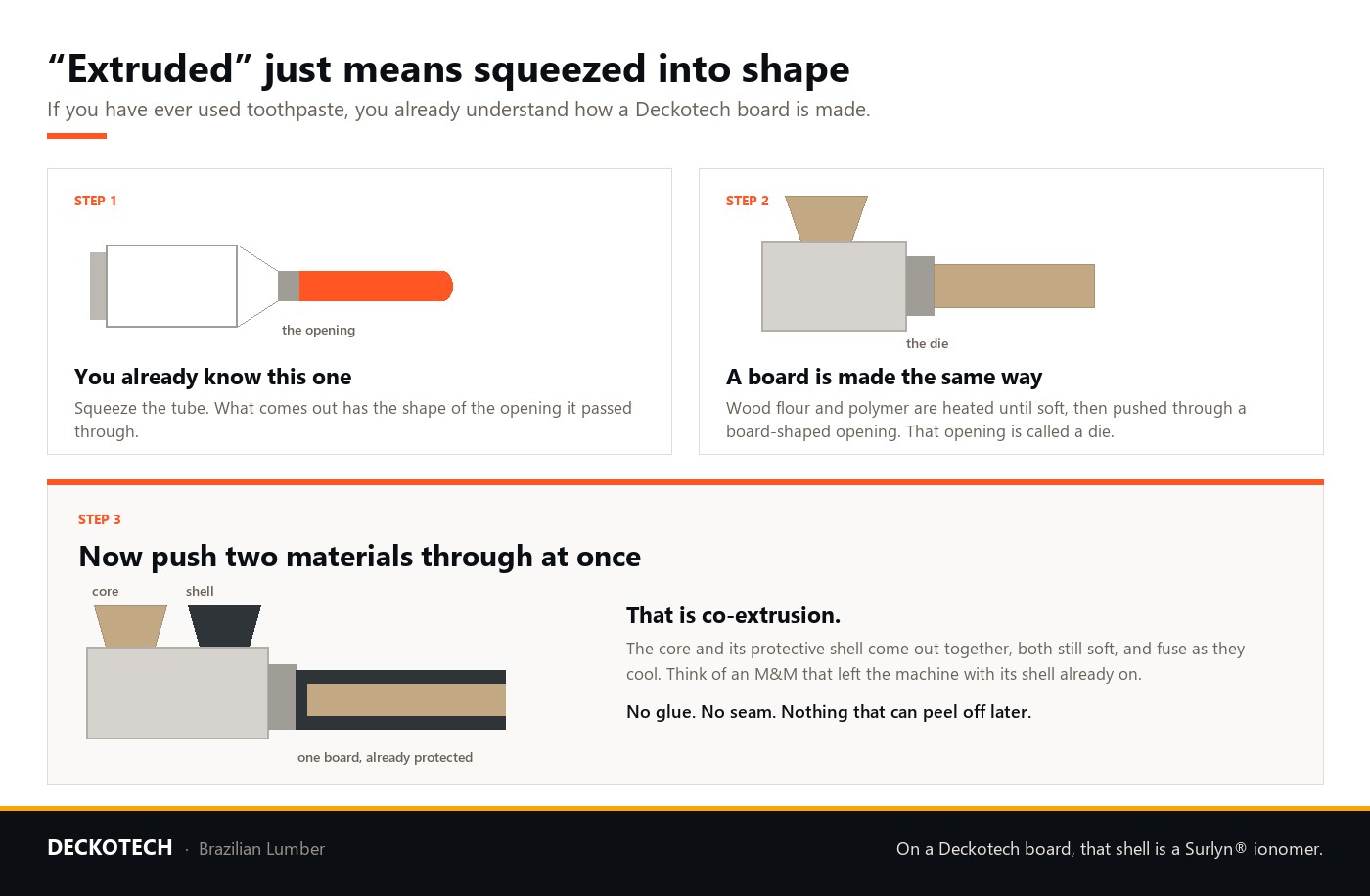
That’s the whole difference between a cap and a coating. A coating is applied to a finished board and there’s a seam between the two, which is what eventually chips, peels or sands through. A co-extruded cap has no seam to fail: it’s the board. This is the manufacturing step that separates capped composite decking from painted, filmed or wrapped alternatives — and on a Deckotech board, the layer being co-extruded onto that core is a Surlyn® ionomer.
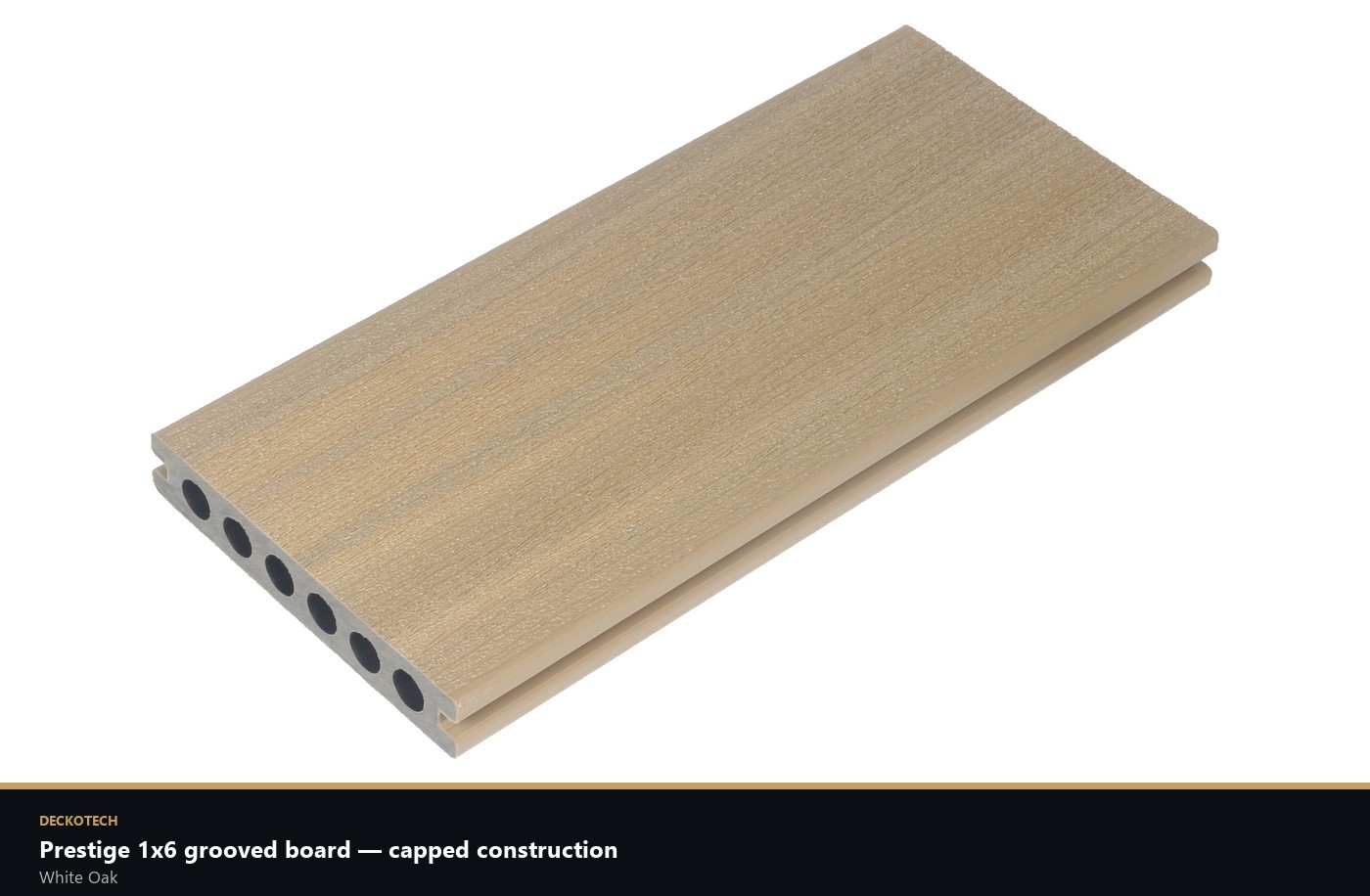
A Deckotech board comes out of that process in three layers:
- Protective Shield — the outer cap. Color, texture, UV defense, stain and scratch resistance. This is the layer that ages.
- Durable Core — the structural composite. Wood flour plus polymer, engineered for span and stiffness. It never sees daylight.
- Reinforced Back — the underside, engineered so the board doesn’t cup or bow when the top and bottom take on moisture at different rates.
The three-layer build is standard practice across the premium end of the category. Where brands actually differ is the resin they pick for that outer shell — and that’s the part nobody publishes.
What are decking caps usually made of?
Here is where brands actually differ, and where almost nobody gives you a straight answer. Across the market the outer cap is usually one of four plastics. Each is a sensible choice, and each has a known weak spot:
| Cap resin | Typical strength | Typical weakness |
|---|---|---|
| HDPE | Cheap, easy to co-extrude with a PE-based core, good moisture barrier | Softer surface; scratches show more readily |
| Polypropylene (PP) | Stiffer and more heat-tolerant than HDPE | Lower impact resistance in cold |
| PVC | Excellent stain and moisture resistance | Uses plasticizers that can migrate over time, which is a common cause of surface chalking |
| Acrylic | Very good color and gloss retention | Brittle under sharp impact |
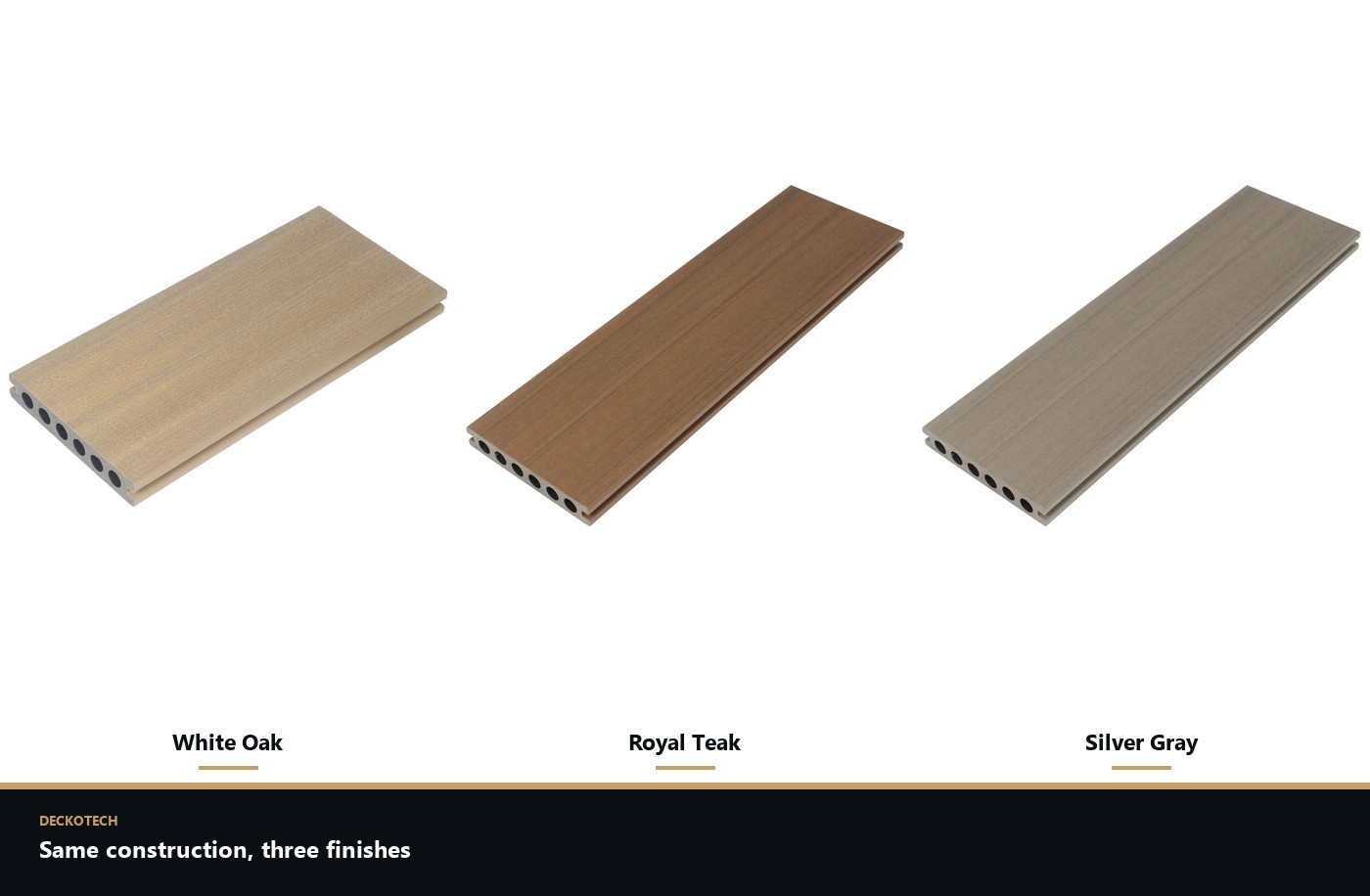
Those four cover the large majority of capped composite decking sold in the United States. Deckotech uses a fifth option that’s common in other industries and rare in this one.
What is Surlyn®, and why put it on a deck board?
Deckotech uses a fifth option: Surlyn®. You’ve almost certainly touched it without knowing. It’s the material used for the outer cover of golf balls, and for the trim on the outside of cars. Both jobs involve getting hit, scraped and left out in the weather, which is exactly what a deck surface has to survive. Technically it’s an ionomer resin, developed by DuPont and now sold under Dow.
Deckotech states it directly on its product pages: the boards are built with "advanced co-extrusion technology combining composite core with Surlyn® polymer layer," using the same technology found in golf ball construction.
Three properties carry over usefully to a deck:
- Cut and abrasion resistance. DuPont describes Surlyn ionomers as having excellent impact toughness, flexibility, and cut and abrasion resistance. On a deck that’s patio furniture being dragged, dog claws, and grit under shoes.
- No liquid plasticizer. Surlyn requires no liquid plasticizer, so there’s nothing in the cap that can migrate out of the finished part. Plasticizer migration is one of the mechanisms behind chalky, dull-looking surfaces on some older plasticized caps.
- Documented outdoor weathering. DuPont reports that parts made with UV-stabilized Surlyn containing carbon black have been in outdoor service for over ten years with no significant change in physical integrity or appearance.
Does capped actually beat uncapped?
For anything outdoors, yes — and it’s not close. Uncapped composite leaves wood flour at the surface. Wood flour absorbs water. Water plus organic material plus Florida humidity is how you get the mold, fade and staining complaints that gave first-generation composite decking its reputation in the 2000s.
The entire premium half of the category moved to capped boards for that one reason. If you’re comparing a cheap uncapped board against a capped board on price per linear foot, you’re not comparing the same product.
Where does the cap matter most?
Not evenly. The cap earns its money in specific places:
- Full sun. South-facing decks with no shade. The cap is the only thing standing between UV and your color.
- Pool and coastal. Chlorine, salt spray and constant wet-dry cycling attack the surface, not the core — as long as the cap holds.
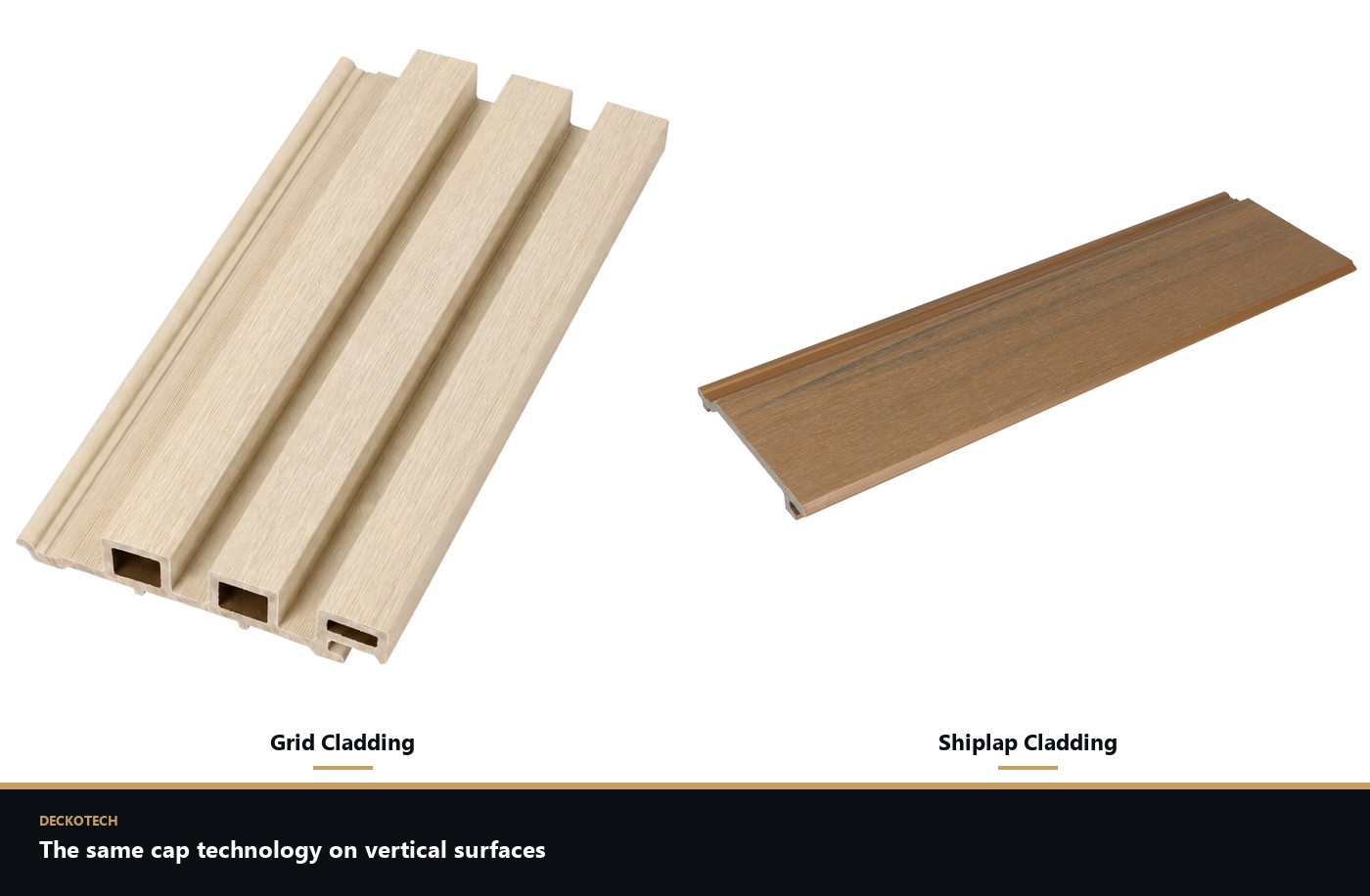
- Vertical surfaces. On composite cladding, the board is at eye level and gets looked at daily. Surface defects that you would never notice underfoot are obvious on a facade. This is why the same cap technology carries over to the Prestige 1×6 Grid Cladding.
- High-traffic commercial. Restaurants, hotel pool decks, rooftop terraces. Abrasion resistance is what you’re paying for.
What a cap doesn’t fix
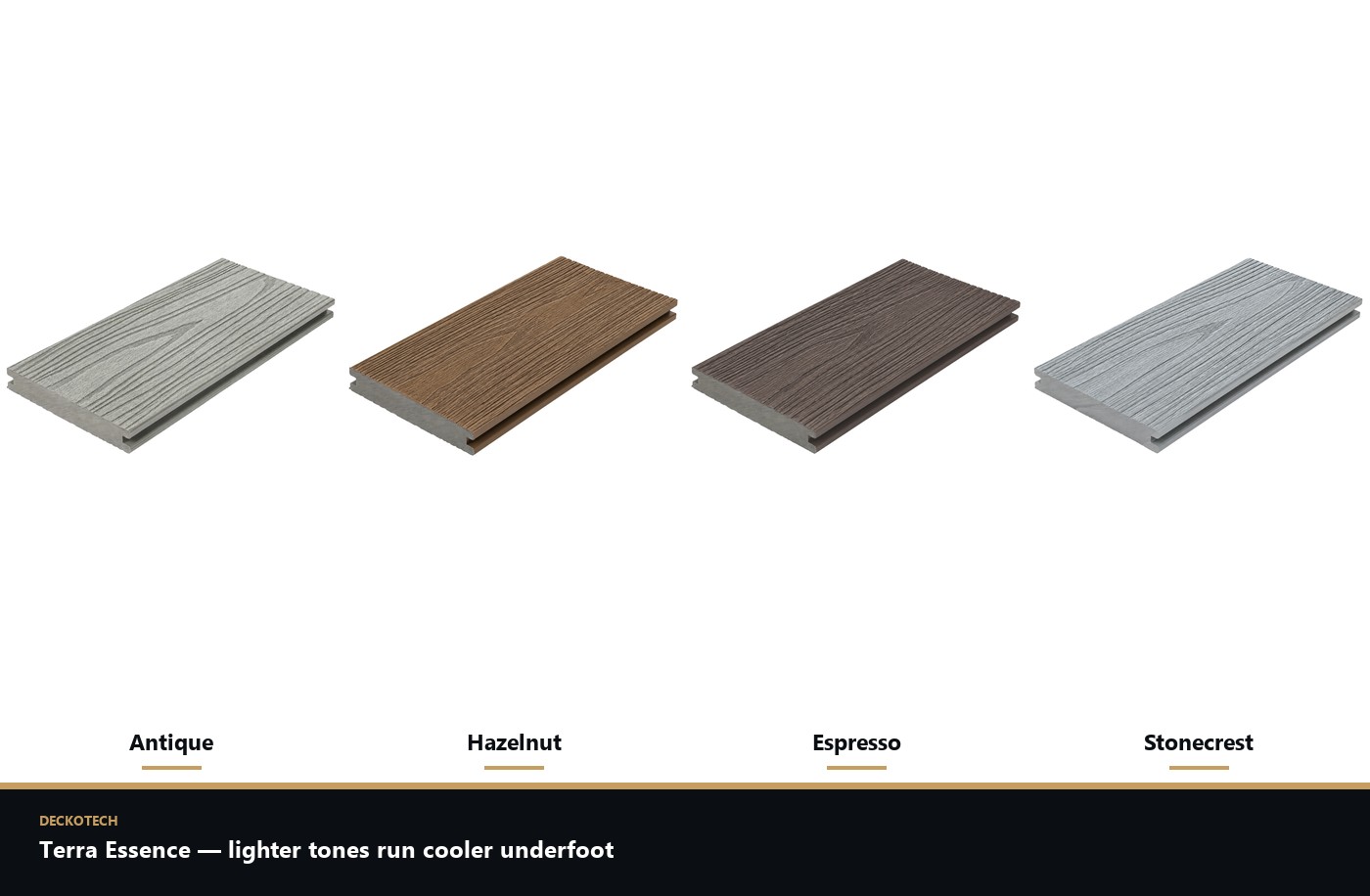
We’d rather be straight with you than oversell. A cap doesn’t make a board fireproof, it doesn’t eliminate thermal expansion, and it doesn’t compensate for bad framing or wrong joist spacing. A dark board in full Florida sun will still get hot underfoot no matter what the cap is made of. Color drives surface temperature far more than cap chemistry does, and how dense the board is plays a part too.
And a manufacturer warranty is a warranty on defined failure modes, not a promise that nothing will ever change. Read what it actually covers. Deckotech backs its boards with a manufacturer limited warranty (confirm current terms with your supplier); the commercial number being lower than the residential number is normal across the industry and reflects an honest difference in duty cycle.
How to compare two capped boards in a showroom
Four questions. They take about ninety seconds and they cut through most marketing:
- What resin is the cap? If the answer is "a proprietary polymer shell," ask again.
- Is it capped on all four sides, or three? Three-sided caps leave the bottom exposed.
- Is the cap UV-stabilized for exterior service, and can you show the data?
- What is the actual board dimension, not the nominal? A Deckotech Prestige decking board is nominally 1" x 6" and actually 0.86" x 5.5" (22 mm x 140 mm) in 16 ft lengths. The Prestige 1×6 Grid Cladding profile is a different section again, at 0.98" x 5.74" (25 mm x 146 mm). Those differences change your board count, so always ask which figure you’re being quoted.
Ask whether you can take a sample to site. Leave it exposed outdoors for a week. Move a chair across it to check how the surface takes scuffing. A single afternoon of testing tells you more than any brochure will.
Frequently asked questions
What is a cap on composite decking?
The cap is a thin polymer shell co-extruded onto the board core during manufacturing. It carries the color and takes all the wear, so the wood-flour core never touches sun, rain or foot traffic.
What is Surlyn and why use it as a decking cap?
Surlyn is an ionomer resin from DuPont, now under Dow, best known as the cover material on golf balls and on automotive exterior trim. Its ionic crosslinks give it high impact toughness and cut and abrasion resistance, and it uses no liquid plasticizer, so there’s nothing in the cap that can migrate out and chalk the surface.
Is capped composite decking better than uncapped?
For outdoor use, yes. Uncapped composite exposes wood flour directly to moisture, which is what drives the fading, staining and mold problems associated with first-generation composite decking.
Does a cap stop composite decking from getting hot?
No. Surface temperature is driven mainly by color, not by cap chemistry. A dark board in full Florida sun gets hot whatever the cap is made of. If barefoot comfort matters, choose a lighter color first and worry about cap resin second.
How thick is the cap?
Cap thickness varies by manufacturer and is rarely published as a single number, because it’s not uniform around the profile. The more useful question is whether the board is capped on all four sides, since a three-sided cap leaves the underside exposed to moisture from below.
How long does a capped composite board last?
Deckotech backs its boards with a manufacturer limited warranty (confirm current terms with your supplier). Warranty length is a floor set by the manufacturer, not a forecast — actual service life depends on exposure, color, substrate and how the deck was framed.
What does co-extruded mean on a decking spec sheet?
Extruded means the board was formed by pushing heated material through a shaped opening, like toothpaste from a tube. Co-extruded means the core and the protective cap were pushed through together while both were molten, so they fused into one piece rather than being layered on afterwards. A co-extruded cap can’t peel, because there’s no seam between it and the core.
Sources
- DuPont™ Surlyn® ionomer resin technical datasheets (8920 sodium, 9720 zinc, 9910 zinc) — impact toughness, cut and abrasion resistance, absence of liquid plasticizer, outdoor weathering of UV-stabilized grades with carbon black.
- SURLYN™ ionomer product page, Dow Inc.
- Deckotech product specifications, deckotech.us — co-extrusion with Surlyn® polymer layer, a manufacturer limited warranty (confirm current terms with your supplier), actual decking board dimensions 0.86" x 5.5" (22 mm x 140 mm) in 16 ft lengths, and Prestige 1×6 Grid Cladding at 0.98" x 5.74" (25 mm x 146 mm).
- Decks.com and Trex Protect technical references on capped composite construction and common cap resins (HDPE, PP, PVC, acrylic).
- Ionomer overview, ScienceDirect Topics — weathering behavior of ionomers and the requirement for UV stabilization.
Explore the full range of Deckotech composite systems, or see the boards in this article in the decking range.