What is the best composite decking for full sun?
Table of contents
13 sections
Full sun does two different things to a deck, and most people only think about one of them. Heat is the one you feel on day one. Fading is the one you notice three summers in.
Why does one board get hotter than another?
Solar absorptance. A dark surface absorbs more of the sun’s energy and re-emits it as heat. That holds for composite, PVC, aluminum, concrete and natural wood alike, though not to the same degree: a denser board stores more heat, and a conductive material like aluminum passes it to your foot faster. So this isn’t a composite problem. A dark stained ipe deck gets brutally hot too.
Cap chemistry has almost nothing to do with barefoot comfort. Anyone selling you a cap as a heat solution is overselling it. Color is the lever you actually control. Board density and whether the profile is solid or hollow have a secondary effect on how fast the surface sheds heat, but color dominates.

What actually causes fading, and what stops it?
Ultraviolet radiation breaks polymer chains and degrades pigment. On an uncapped composite board the pigment and the wood flour sit right at the exposed surface, so UV reaches both. On a capped board the pigment lives inside the cap, and the cap carries the UV stabilizer package.
This is where cap chemistry actually matters. Deckotech uses a co-extruded Surlyn® ionomer cap. DuPont reports that parts made with UV-stabilized Surlyn containing carbon black have been in outdoor service for over ten years with no significant change in physical integrity or appearance. Surlyn also requires no liquid plasticizer, so there’s nothing that can migrate out and produce the chalky, dull look that some plasticized caps develop.
Raw ionomers weather poorly, and they have to be UV-stabilized to survive outdoors. That stabilization is the whole point. Ask any supplier whether their cap is stabilized for exterior service and expect a straight answer.
How to choose a color for an unshaded deck
| Deckotech color | Relative tone | Best use in full sun |
|---|---|---|
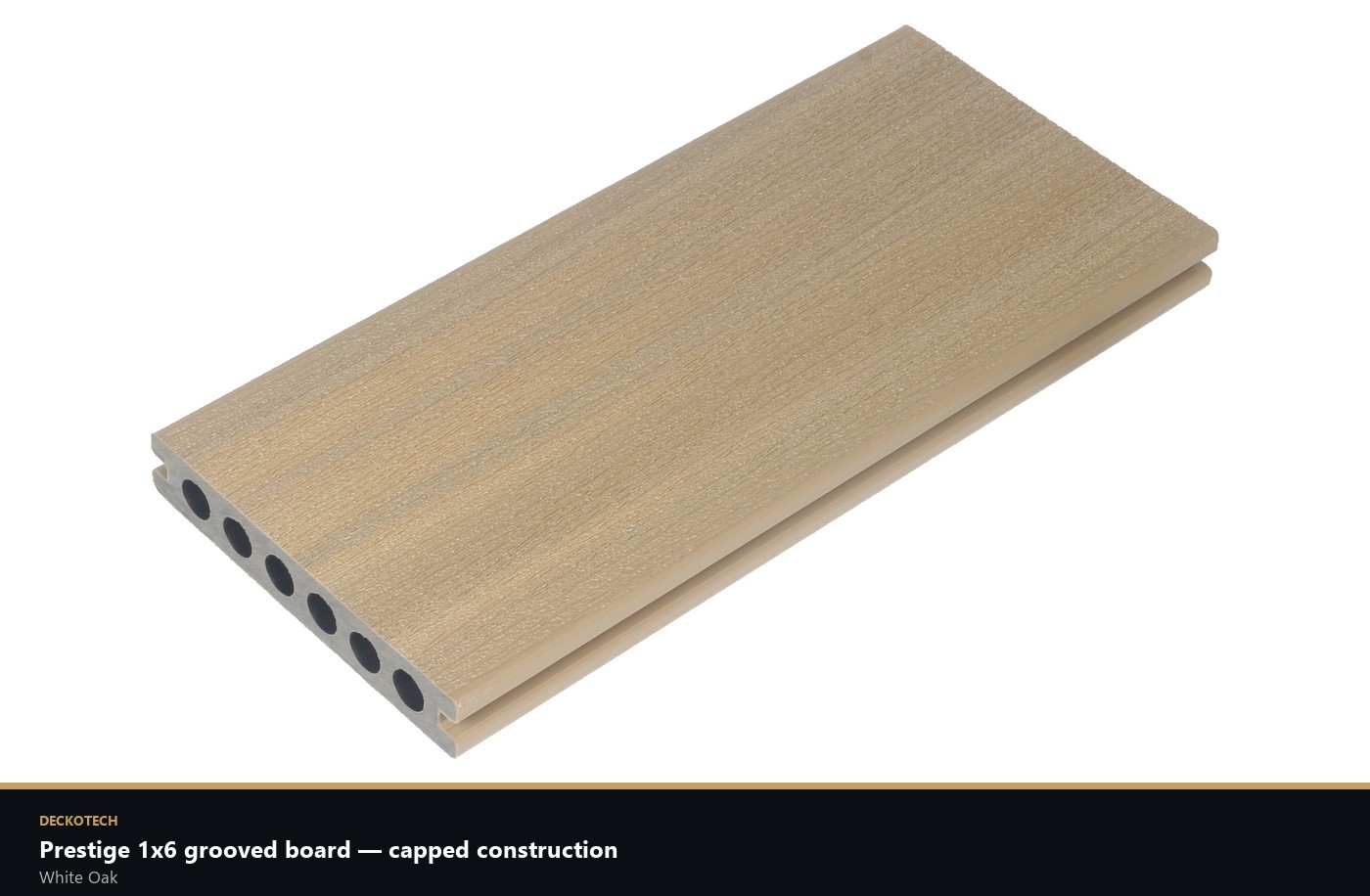
| White Oak | Light | Pool surrounds, barefoot areas, large unshaded decks |
| French Oak | Light-mid | General unshaded decking, good balance of warmth and comfort |
| Ashwood Gray / Silver Gray | Light-mid | Coastal projects, hides salt and dust between cleans |
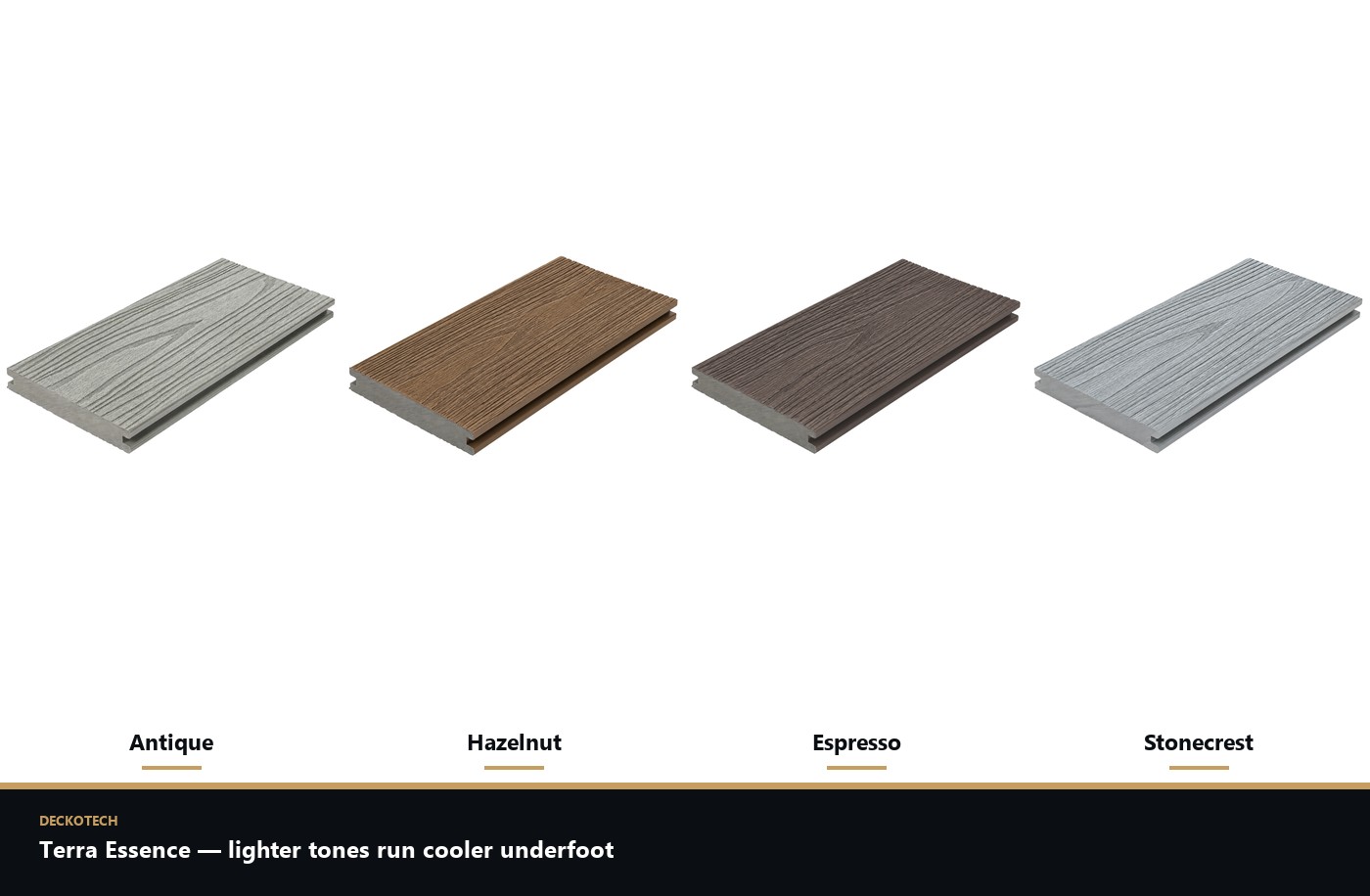
| Honey Oak (Terra) | Light-mid | Residential decks, warm natural read |
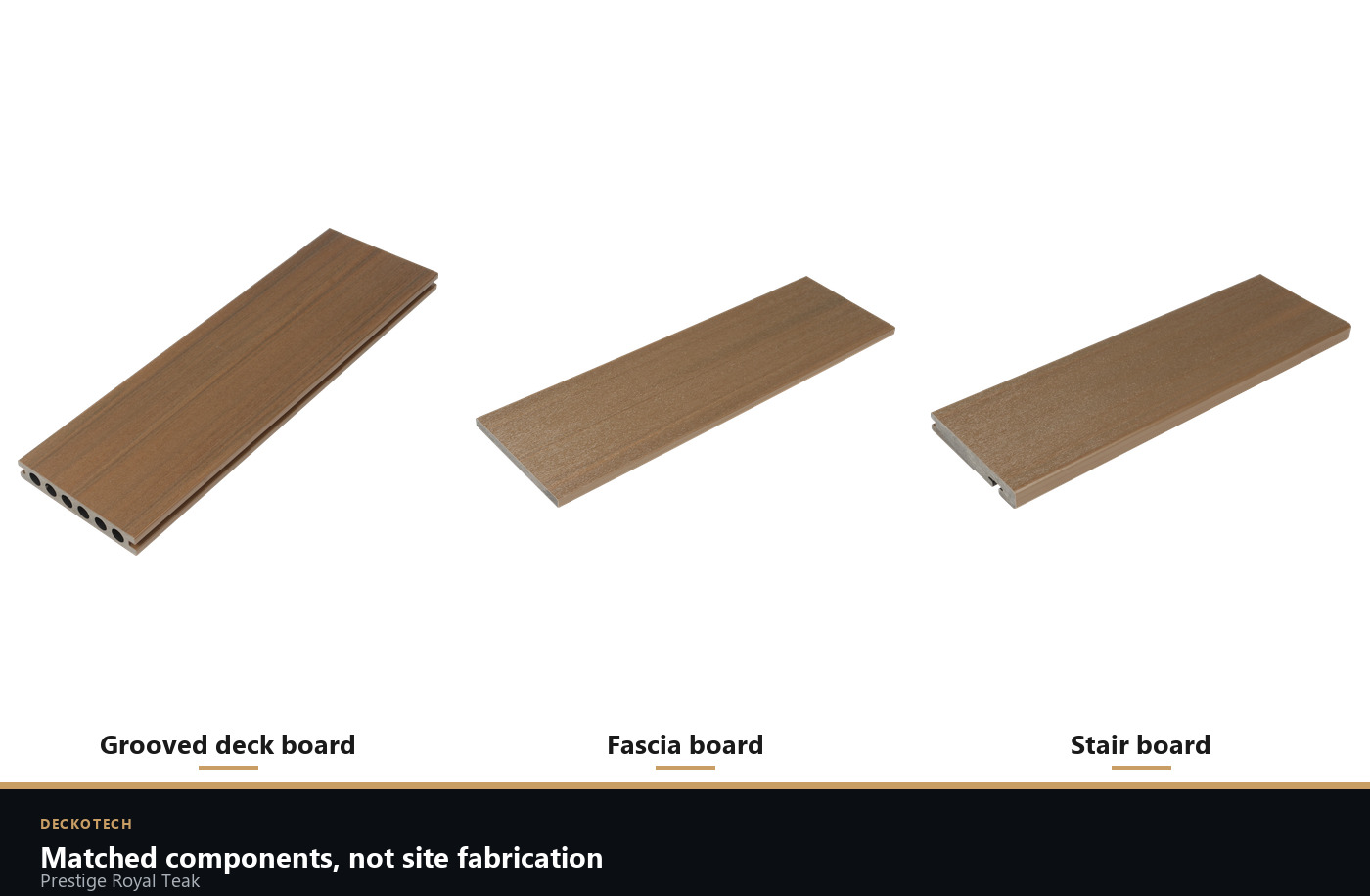
| Royal Teak | Mid | Great color depth; comfortable in partial shade, warm in full sun |
| Northern Walnut / Forest Walnut | Mid-dark | Shaded decks, cladding, fencing |
| Charcoal / Mineral Black / Ebony | Dark | Cladding, fencing, gates, screens — vertical or shaded, not barefoot surfaces |
Deckotech Prestige decking boards are nominally 1" x 6" and actually 0.86" x 5.5" (22 mm x 140 mm) in 16 ft lengths. Use the actual figure when you calculate board count, not the nominal one.
Where dark boards are the right answer
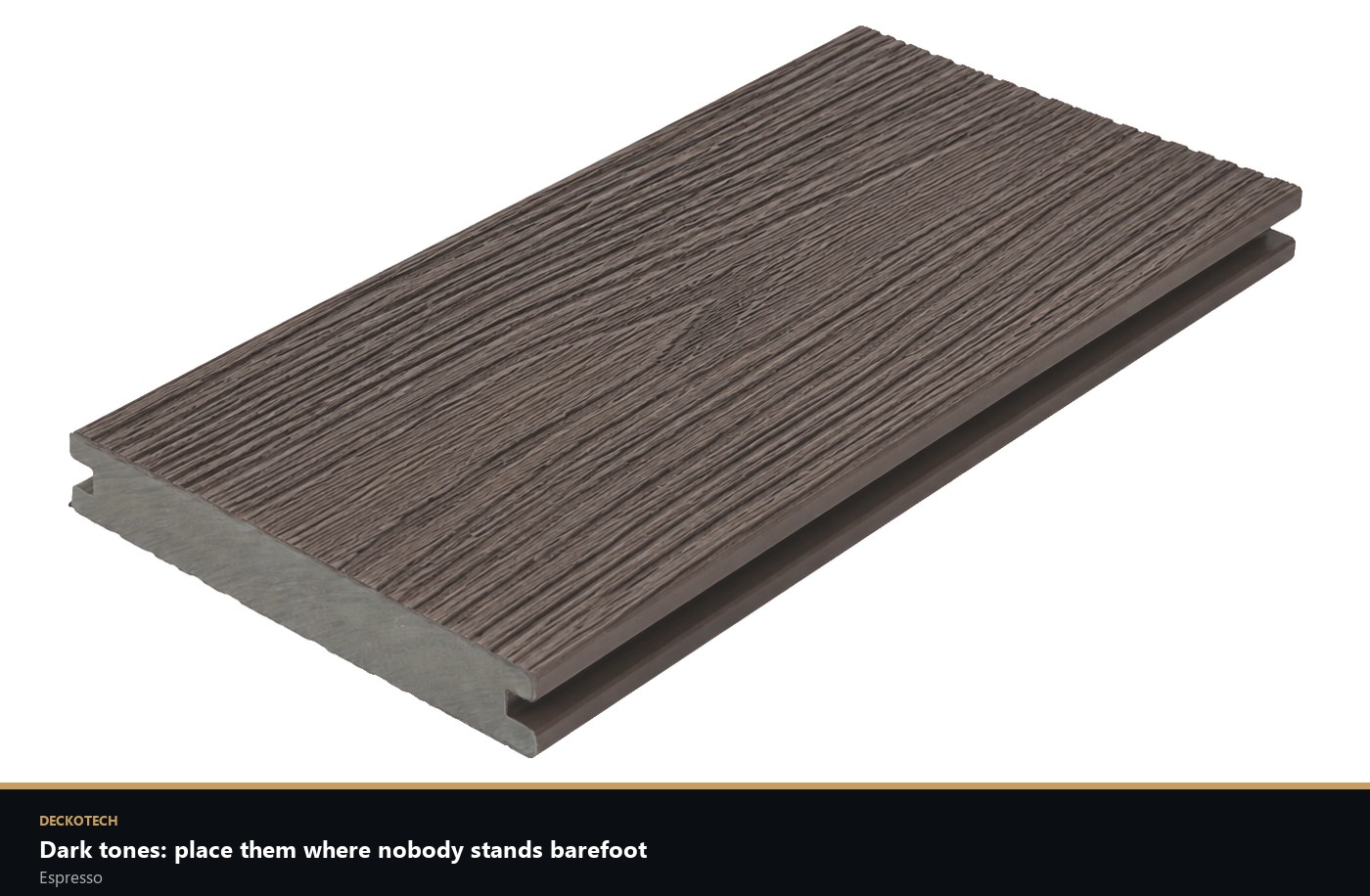
Dark composites aren’t a mistake. It’s about where you use them. Nobody stands barefoot on a fence or a facade. Charcoal, Mineral Black and Ebony are excellent on vertical surfaces where the color does the design work and the heat is irrelevant.
- Cladding and facades. Dark cladding looks deliberate and hides dirt streaking well.
- Fencing and gates. Ebony and Royal Teak on a fence line give the boundary a finished, deliberate look.
- Screens, battens and louvers. Depth of shadow is the point; dark tones exaggerate it.
- Covered outdoor rooms. Under a roof, heat stops being a factor and you can choose on looks alone.
A simple test before you commit
- Get physical samples of two or three candidate colors, including one that’s lighter than you think you want.
- Put them on the actual site, in the actual orientation, for a full week.
- Check their surface temperature barefoot at 2 pm, not at 9 am, when every surface feels comfortable.
- Look at them at dusk and again at midday. Color looks completely different under low-angle light.
- Move a chair across them to check how the surface takes scuffing. You’ll learn more in ten seconds than a spec sheet will tell you.
It costs you a week and nothing else, and it settles the argument better than any brochure. And if a supplier won’t send samples for a real project, find another supplier.
Frequently asked questions
Which composite decking color stays coolest?
Lighter colors run cooler. Across every capped composite brand, a light gray or oak tone will feel noticeably cooler underfoot than a charcoal or black board in the same product line, because surface temperature is driven mainly by solar absorptance, not by cap chemistry.
Does composite decking fade in full sun?
All exterior surfaces change slightly. A capped board fades far less than an uncapped one because the cap carries UV stabilizers and the pigment sits inside the cap rather than at the exposed surface. Most premium warranties define fade as a measured color change over a set period, not as zero change.
Can I use dark composite decking in Florida?
Yes, but place it deliberately. Dark boards are excellent for shaded decks, covered patios, vertical cladding and fencing, where nobody stands barefoot. For an unshaded pool surround in South Florida, a lighter tone is simply the smarter call.
Does a capped board get less hot than an uncapped one?
Not really. The cap handles UV and stain resistance. It doesn’t change how much heat the board takes on. Two boards of the same color, one capped and one not, will feel similar underfoot on day one. The difference shows up years later in how they look.
Do lighter decks show dirt more?
Slightly, but less than people expect. Mid-tone grays and oaks hide dust, pollen and salt residue better than either very dark or very light boards, which is why Ashwood Gray and Silver Gray perform well on coastal projects.
Sources
- DuPont™ Surlyn® ionomer resin technical datasheets — outdoor weathering of UV-stabilized grades, absence of liquid plasticizer.
- Deckotech product specifications, deckotech.us — color ranges by collection, actual board dimensions, a manufacturer limited warranty (confirm current terms with your supplier).
- Ionomer overview, ScienceDirect Topics — weathering behavior and UV stabilization requirement.